 Author
Chief Revenue Officer & Global Marketing Head
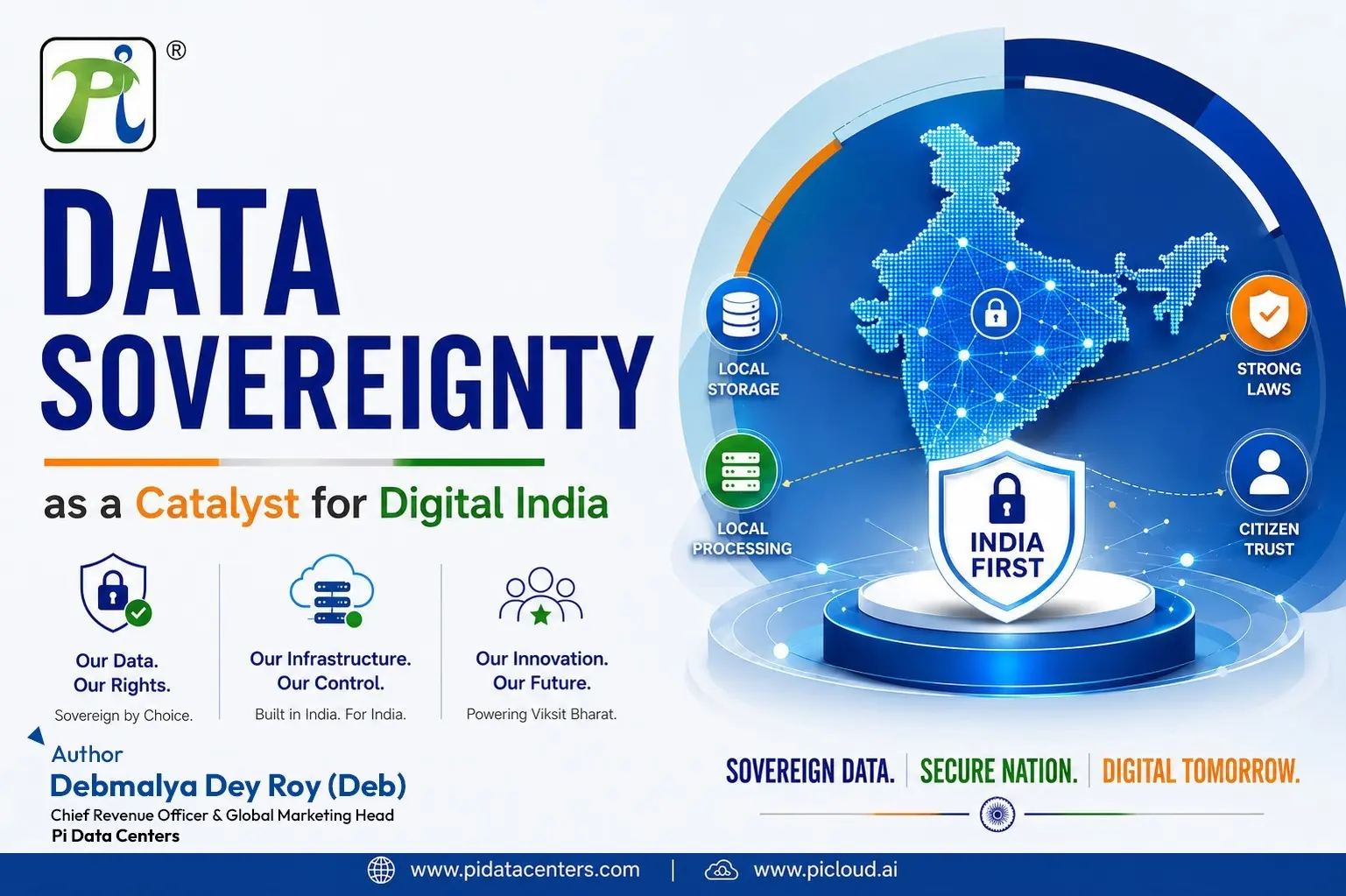
Data Sovereignty as a Catalyst for Digital India
This article explores the transformative impact of the Digital Personal Data Protection (DPDP) Act, 2023 (and its 2025 Rules ) on the Indian data center industry as of 2026. It specifically analyses how Pi Data Centers serves as a cornerstone for Digital India, enabling sovereignty, resilience, and industrial growth.
1. Navigating the DPDP Landscape
A. The New Regulatory Paradigm (2026)
The full enforcement of the DPDP Act in 2026 has transitioned India from a voluntary privacy regime to a mandatory, citizen-centric framework. The Act treats personal data not as a corporate asset, but as a "trust" held on behalf of the Data Principal.
B. Core Tenets of the 2026 Regulatory Environment:
- Enforceable Rights: Citizens now exercise the Right to Correction, Erasure, and Access, requiring infrastructure that can perform rapid, granular data operations.
- The 90-Day Mandate: Data Fiduciaries must address all principal requests within a strict 90-day window, putting immense pressure on legacy storage systems.
- Financial Accountability: Penalties of up to ₹250 Crore for failing to prevent breaches have elevated data center security from an "IT cost" to a "Boardroom Risk."
2. Role of Indian Data Center Players
Indian data center providers have evolved from simple "space and power" vendors into Compliance Orchestrators. In the current industry, their role is defined by three factors:
- A. Data Localization Excellence: While global transfers are permitted to "notified" countries, the 2026 landscape shows a clear preference for local storage to avoid the legal volatility of international data treaties.
- B. Infrastructure-as-Law: Data centers now integrate "Privacy-by-Design" at the hardware level, offering immutable logs and automated data lifecycle management to satisfy the Act's audit requirements.
- C. Hyperscale Support: Local players provide the landing zones for global cloud providers, ensuring that foreign entities can serve Indian users without violating sovereignty norms.
3. Pi Data Centers: Adding Value to the DPDP Framework
Pi Data Centers differentiates itself by bridging the gap between high-end digital infrastructure and the specific legal mandates of the DPDP Act.
A. "Safe Harbor" in Amaravati, Hyderabad, and Mumbai
By maintaining a strictly domestic footprint, Pi eliminates the complexity of cross-border "Negative Lists." For highly regulated sectors like BFSI, Healthcare, Pharma, Government, e-Commerce, Payment Gateways, Trading and similarly others, Pi acts as a "Safe Harbor" where data resides under Indian jurisdiction, simplify legal discovery and regulatory oversight.
B. The PiCloud® Advantage: Sovereign Cloud Architecture
Pi's proprietary cloud, PiCloud®, is built on a "Sovereign Stack." This ensures:
- Zero-Leaking Metadata: Unlike many global clouds, Pi ensures that even metadata (data about data) remains within Indian borders.
- Automated Data Deletion: Pre-built workflows allow clients to automate the "Right to be Forgotten," ensuring data is purged across all backups and mirrors once consent is withdrawn.
C. Resilience-as-a-Service (RaaS)
Recognizing that "Data Availability" is a core pillar of the Act, Pi's TIER IV / Rated-4 facilities provide the 99.995% uptime necessary to ensure that Data Principals can access their information 24/7, as legally mandated.
Author
Chief Revenue Officer & Global Marketing Head
4. Strengthening the "Digital India" Perspective
Pi Data Centers does not just facilitate compliance; it actively strengthens the Digital India mission by:
- Empowering Digital Public Infrastructure (DPI): Pi provides the high-compute backbone for India's expanding DPI, ensuring these citizen-scale platforms can be hosted on resilient, indigenous soil.
- Cost Democratization: By offering local, compliant cloud services, Pi allows Indian Enterprises, Global MNCs operating in India, MSMEs and startups to comply with the DPDP Act without the "Global Cloud Premium," levelling the playing field for domestic innovation.
- Strategic Autonomy: In an era of "Splinternets" and data nationalism, Pi ensures that India's data—the fuel for its AI and digital economy—is not subject to foreign sanctions or policy shifts.
D. Implementation Roadmap
| Roadblock | Strategic Solution | Role of Infrastructure |
|---|---|---|
| Legacy Systems | External Encryption/Tokenization | Hosting secure "Compliance Layers" |
| Consent Scale | Automated Consent Managers | High-compute real-time logging |
| Sovereignty Risks | Regional Data Localization | Localizing storage in Indian regions |
| Breach Liability | 72-Hour Response SOPs | Resilient hosting to prevent downtime |
The solution for 2026 lies in moving away from "Policy-only" compliance to "Technology-embedded" compliance. Organizations that leverage local, resilient infrastructure to automate their data governance will be the ones to avoid the ₹250 crore penalty cliff in 2027.
5. Conclusion: The Path to 2047
In alignment with the 2026 Union Budget and the vision of Viksit Bharat 2047, Pi Data Centers role is more than just a service provider. By harmonizing the rigorous requirements of the DPDP Act with world-class infrastructure, Pi is ensuring that as India becomes a global digital superpower, its foundation remains Resilient, Sovereign, and Connected.
For enterprises, the transition to Pi Data Centers in 2026 represents a shift from "Managing Data" to "Governing Trust." In the DPDP era, trust is the only currency that scales.