 Author
Chief Revenue Officer & Global Marketing Head
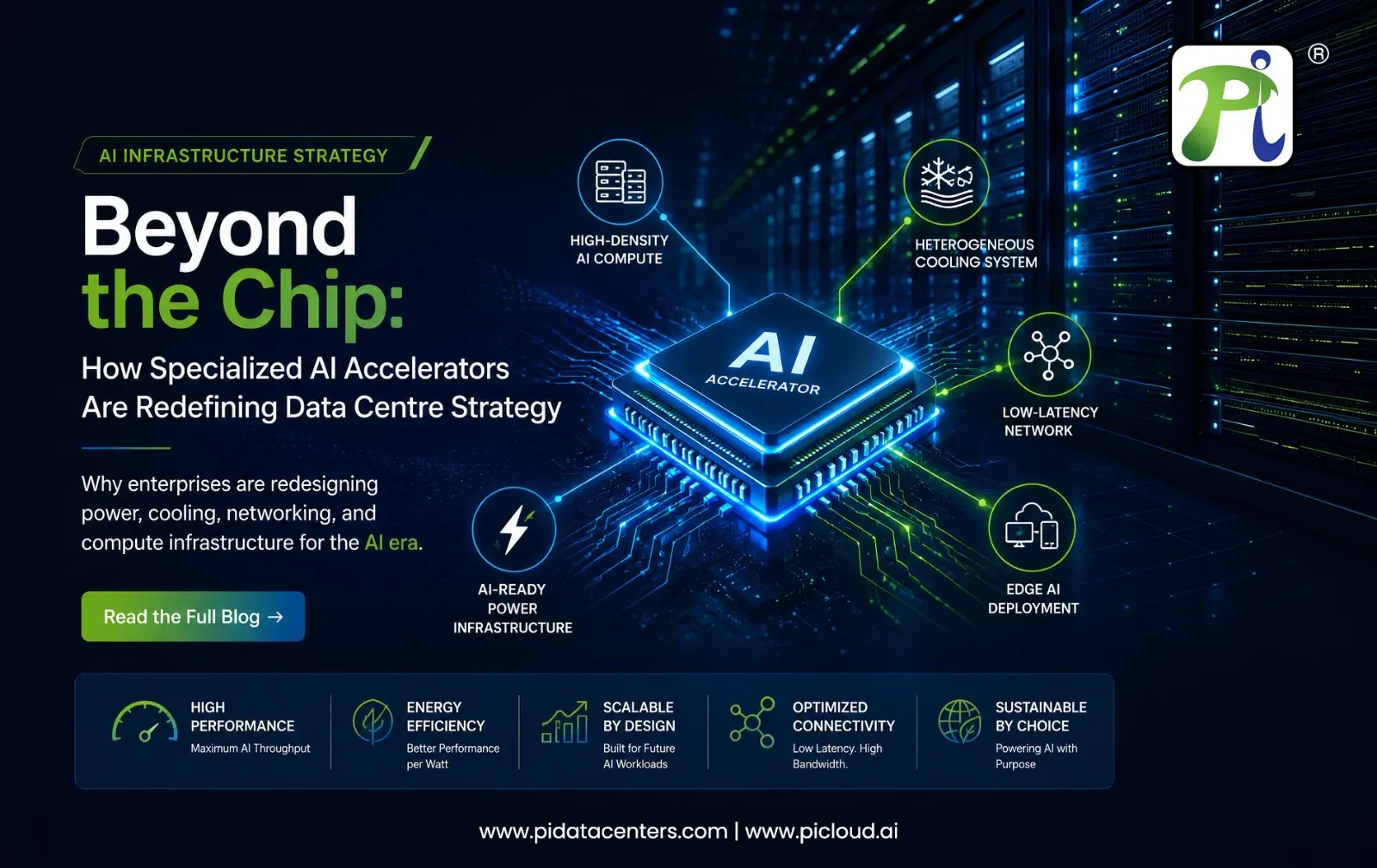
Beyond the Chip: How Specialized AI Accelerators are Redefining Data Centre Strategy
Artificial intelligence is no longer limited to experimentation environments. Today, enterprises are deploying AI across customer engagement, cybersecurity, manufacturing, analytics, automation, and decision-making systems at scale. As AI adoption accelerates, organizations are rethinking one critical question:
Can traditional data center infrastructure support the demands of modern AI workloads?
The answer is increasingly no.
AI workloads demand:
- High-performance parallel compute
- Ultra-fast data processing
- Real-time inference execution
- Low-latency networking
- Significantly higher power density.
As a result, enterprises are shifting from conventional infrastructure planning to AI-ready infrastructure strategies powered by specialized AI accelerators.
The Growing Infrastructure Challenge
Traditional enterprise data centers were designed for predictable business applications such as:
- Virtualization
- Databases
- ERP systems
- Storage
- Transactional workloads.
Key Enterprise Challenges Driving Infrastructure Redesign
| Infrastructure Challenge | Impact on Enterprises |
|---|---|
| Rising AI inference workloads | Continuous compute demand increases operational costs |
| High rack power density | Existing facilities struggle to support AI clusters |
| Cooling limitations | Traditional air cooling becomes insufficient |
| Latency-sensitive AI applications | Real-time AI requires ultra-fast processing |
| Sustainability pressures | AI energy consumption impacts ESG goals |
| Scaling AI environments | Conventional infrastructure lacks flexibility |
Traditional enterprise racks previously operated at approximately 10–15 kW per rack, while modern AI accelerator clusters can exceed 100 kW per rack, forcing organizations to redesign power and cooling infrastructure.
Why Specialized AI Accelerators Matter?
Initially, enterprises relied heavily on general-purpose accelerators because of their flexibility. However, as AI workloads moved into production, organizations realized that generalized compute was not always the most efficient option for:
- High-performance parallel compute
- Ultra-fast data processing
- Large-scale inference
- Real-time AI
- Edge intelligence
- High-volume AI operations
Specialized AI accelerators solve this challenge by optimizing hardware for specific AI operations.
Benefits of Specialized AI Accelerators
- Improved AI performance
- Lower latency
- Reduced power consumption
- Better performance-per-watt
- Lower operational costs
- Faster AI inference execution
- Improved scalability for enterprise AI environments
This shift is transforming how enterprises design AI-ready infrastructure.
Understanding the AI Accelerator Ecosystem
As enterprises scale AI adoption, different types of AI accelerators are being used to support specific workloads, performance requirements, and operational goals. Each accelerator architecture is designed to optimize a particular aspect of AI processing, such as training, inference, latency, power efficiency, or edge deployment.
Comparison of Specialized AI Accelerators
| Accelerator Type | Primary Use Case | Key Advantage |
|---|---|---|
| TPUs (Tensor Processing Units) | Large-scale AI training and inference workloads | Deliver high throughput and improved energy efficiency for AI processing |
| ASICs (Application-Specific Integrated Circuits) | Dedicated AI operations and high-volume inference workloads | Provide optimized performance-per-watt and lower operational costs |
| LPUs (Language Processing Units) | Generative AI, conversational AI, and large language models (LLMs) | Enable ultra-low-latency AI inference and faster response times |
| FPGAs (Field-Programmable Gate Arrays) | Real-time AI processing and adaptable enterprise workloads | Offer reprogrammable hardware flexibility for evolving AI requirements |
| NPUs (Neural Processing Units) | Edge AI and on-device AI inference | Support low-power, high-efficiency AI processing at the edge |
Author
Chief Revenue Officer & Global Marketing Head
One of the biggest changes in enterprise AI infrastructure is the move toward heterogeneous computing environments. Instead of relying on one universal compute architecture, enterprises are deploying multiple accelerator types together to support different AI workloads.
Modern AI Infrastructure Typically Includes
- High-performance AI training clusters
- Inference-optimized environments
- Real-time low-latency AI systems
- Edge AI deployments
- Distributed AI processing frameworks
This workload-specific infrastructure strategy improves:
- Scalability
- Efficiency
- Application performance
- Operational economics.
What This Means for Enterprise Infrastructure Strategy?
AI accelerators are not just changing compute architecture. They are reshaping the entire data center ecosystem.
Power and Cooling Become Strategic Priorities
Modern AI environments require:
- High-density power architecture
- Scalable electrical distribution
- Heterogeneous cooling systems (Water cooling, liquid cooling, and others)
- Precision airflow management
- Intelligent thermal optimization. Cooling is no longer just an operational necessity; it has become a competitive infrastructure capability.
Networking Becomes Critical for AI Performance
AI workloads require extremely fast communication between:
- Accelerators
- Storage environments
- AI models
- Enterprise applications
- Low-latency networking
- High-bandwidth interconnects
- Intelligent workload orchestration
Sustainability Is Influencing AI Infrastructure Decisions
As AI adoption grows, enterprises are also under pressure to meet sustainability and ESG targets. Specialized AI accelerators help organizations:
- Reduce consumption
- Improve compute utilization
- Lower cooling overhead
- Optimize carbon efficiency.
Conclusion
The future of enterprise infrastructure is no longer built around a single compute model. AI workloads require specialized architectures optimized for performance, efficiency, scalability, and operational intelligence.
Organizations leading AI transformation today are making strategic decisions around:
- Accelerator selection
- AI-ready power infrastructure
- Advanced cooling systems
- Low-latency networking
- Edge AI deployment
The shift toward specialized AI accelerators is not just redefining compute; it is redefining enterprise infrastructure strategy itself. The enterprises that build workload-optimized, AI-ready infrastructure today will be best positioned to scale innovation, improve operational efficiency, and compete effectively in the AI-driven future.