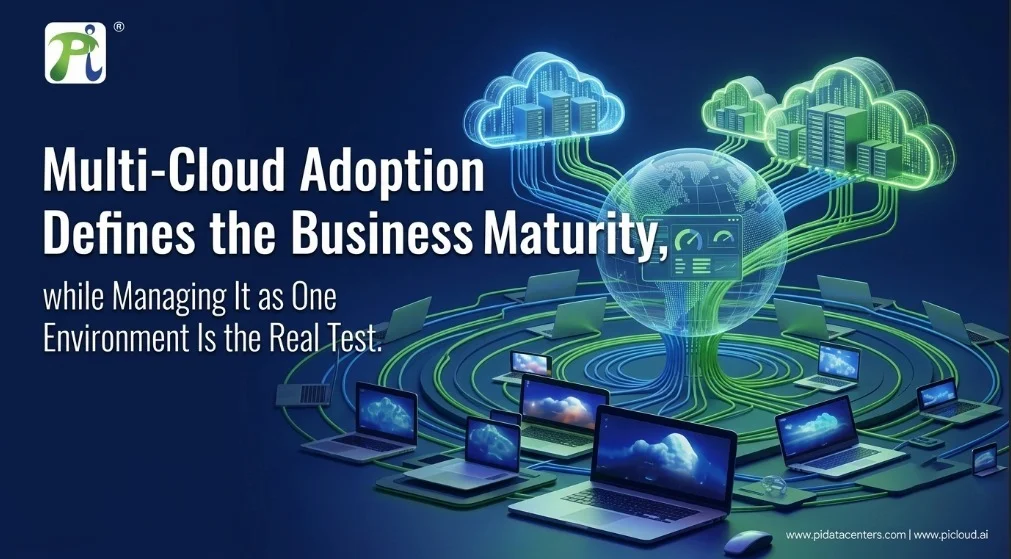
Why Are Enterprises Moving Toward Multi-Cloud?
Using more than one cloud provider can give organizations greater flexibility. But as cloud estates expand, another challenge emerges: how do you manage multiple environments without creating multiple operational silos? That is where multi-cloud strategy becomes more complex.
Enterprises rarely have identical requirements across every workload. One application may require specific AI capabilities. Another may need low-latency infrastructure in a particular geography. Regulated workloads may demand tighter control over data location and access, while business-critical applications may need additional resilience through workload distribution.
As a result, organizations may use different cloud environments for different workloads rather than forcing everything into a single platform.
The Complexity Begins After Adoption
Managing one cloud environment already requires visibility into compute, storage, networking, security, costs, performance, and access. With multiple providers, these considerations become fragmented across different consoles, architectures, policies, billing models, and operational processes.
This can create challenges such as:
- Limited visibility: Teams may not have a unified view of infrastructure and workloads.
- Inconsistent governance: Security, access, and compliance policies can vary between environments.
- Cost fragmentation: Cloud spend becomes harder to track when consumption is distributed across providers.
- Operational complexity: Different tools and processes can increase the burden on IT teams.
- Workload placement issues: Applications may not always run in the environment best suited to their requirements.
The result is a paradox: multi-cloud can increase flexibility while simultaneously increasing management complexity.
From Multi-Cloud Adoption to Multi-Cloud Governance
The next stage of cloud maturity is not about adding another provider simply to increase flexibility. It is about creating a consistent operating model across existing cloud environments, so workloads can be managed with the same level of visibility, control, and accountability regardless of where they run.
As enterprises distribute workloads across multiple cloud platforms, governance becomes critical to prevent fragmented operations, inconsistent policies, and unnecessary costs. This requires organizations to establish common approaches to:
1. Visibility
A multi-cloud environment needs a unified view of workloads, resources, dependencies, utilization, and performance across providers. Without this visibility, teams may struggle to understand how applications are performing or where resources are being consumed.
2. Governance
Security, identity, access, and compliance policies should not vary significantly from one cloud environment to another. Consistent governance frameworks help organizations maintain appropriate controls while reducing policy gaps and operational inconsistencies.
3. Cost Control
Multi-cloud spending can become difficult to track when each provider has different pricing structures, billing models, and usage metrics. Consolidated visibility into consumption helps identify idle resources, unnecessary capacity, and opportunities for optimization.
4. Workload Optimization
Not every workload needs to run in the same environment. Organizations should continuously assess workload placement based on performance, cost, latency, compliance requirements, and business priorities.
5. Resilience
Resilience goes beyond having workloads across multiple providers. Organizations need to understand application dependencies, connectivity, data movement, and recovery requirements across cloud and on-premises environments.
Ultimately, multi-cloud maturity is not measured by how many cloud platforms an enterprise uses. It is measured by how effectively those environments can be governed, optimized, and operated as one cohesive ecosystem.
The Infrastructure Underneath Still Matters
Multi-cloud does not eliminate the need for strong underlying infrastructure. In many enterprise environments, workloads span public cloud, private cloud, colocation, and on-premises infrastructure. This makes connectivity, network performance, data movement, security controls, and operational visibility increasingly important.
The question is no longer simply, “Which cloud should we use?” It is: “How do we make multiple environments work together as one resilient, governed IT ecosystem?”
That shift in thinking is what separates multi-cloud adoption from a mature multi-cloud strategy.
What Enterprises Should Focus on Next
A sustainable multi-cloud strategy should begin with workload requirements rather than cloud-provider preferences. Organizations should continuously evaluate:
- Where does the workload perform best?
- Where can it be governed effectively?
- What does it actually cost to operate?
- What dependencies exist outside the cloud?
- How quickly can it recover if an environment becomes unavailable?
Multi-cloud works best when these questions are answered continuously, not just during the initial migration.